
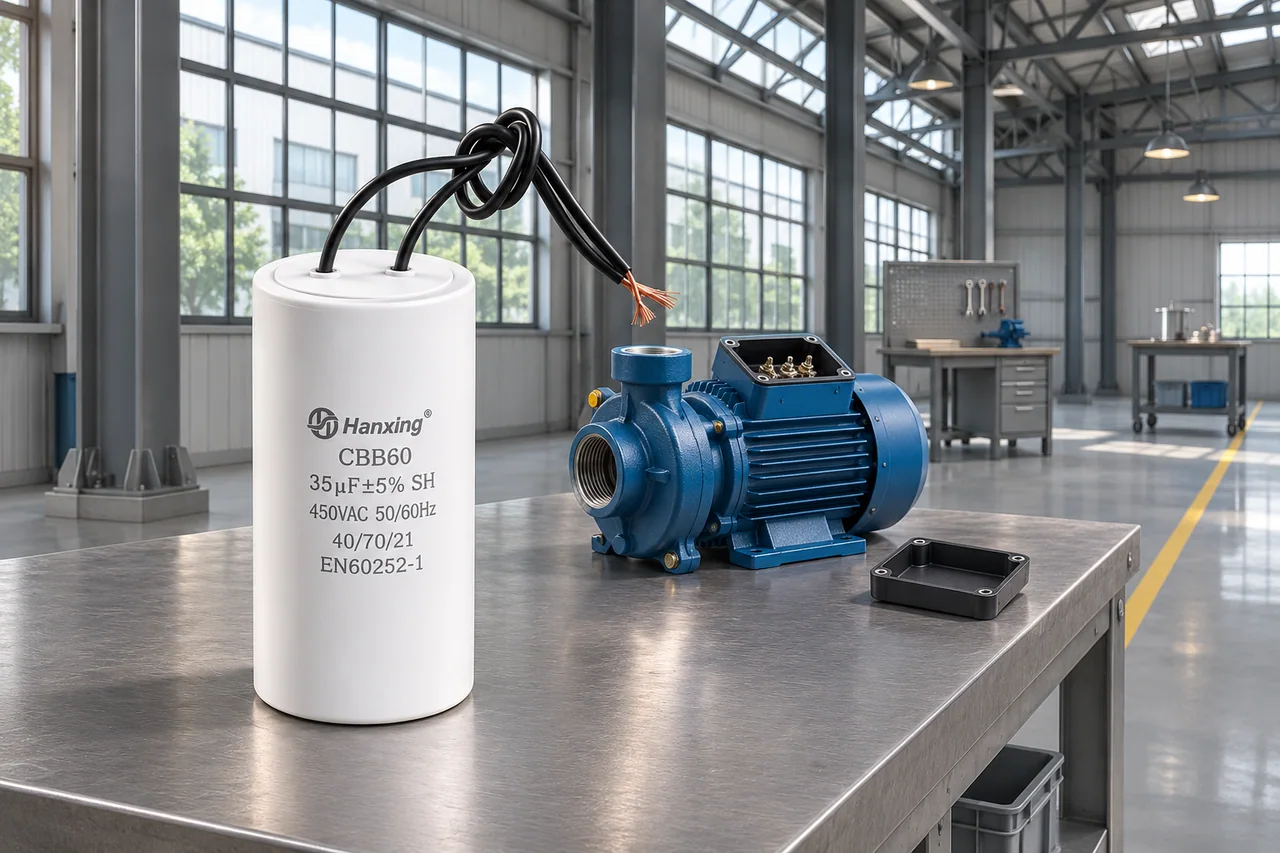
Use the pump motor’s specified capacitance, rated AC voltage and capacitor duty. Pump power alone does not determine µF. A CBB60 is suitable where the motor design calls for a cylindrical film run capacitor; a switched starting circuit needs its specified start capacitor instead.
The same pump power can use a different motor circuit
A centrifugal pump, pool pump or circulation pump can use different motor versions. The pump brand and horsepower are useful identification fields, but the motor model and component schedule determine the capacitor. For a two-speed pool pump, retain the wiring diagram for that exact motor rather than borrowing a value from another pump with the same rated output.
Some motors use a permanently connected run capacitor, some use a switched start capacitor, and some have both. Hot-tub and spa pumps also follow their own motor specification. Inverter-controlled equipment can have a different electrical arrangement, so an external capacitor is not a universal requirement for every pump.
A complete example: 35 µF, 450 VAC, wire leads
The supplied HAN XING CBB60 wired sample is marked 35 µF ±5%, 450 VAC and 50/60 Hz. For a pump motor that specifies this rating, the calculated capacitance limits are 33.25–36.75 µF. These are the nominal tolerance limits from the label; the photograph does not provide a measured test result.
A 25 µF part with the same 450 VAC marking is a different selection. Preserve the specified nominal capacitance and use the voltage rating required by the motor documentation. The voltage across the capacitor in its circuit is separate from the mains supply voltage. Oriental Motor: replacement capacitor guidance
35 µF wired CBB60 sample
The complete original label and both insulated leads are visible.
Will it fit beneath the pump cover?
A pump enclosure can restrict diameter, height and the path of the leads. A stud-mounted capacitor needs its thread and length matched to the mounting point. A quick-connect version needs the correct blade geometry and room for the seated plug. The total connected height can rule out a part whose body fits comfortably.
Record the largest installed envelope the pump allows, then compare it with the proposed drawing. For a sample approval, fasten the part, connect the actual harness and close the cover. Keep that fitted arrangement with the pump motor reference and drawing revision.
Lead exit and base stud
Body height, stud length and connection space are separate measurements.
If the pump hums but will not start
A failed capacitor is one possible cause. Low supply voltage, a loose connection, a locked load or a defective starting switch can produce a similar complaint. A qualified technician needs to isolate the fault before ordering a replacement; repeatedly energizing a stalled motor can overheat it.
Quote the capacitor for your pump motor
Send the motor model, original label and installation dimensions. Keep each pump version on its own order line.