
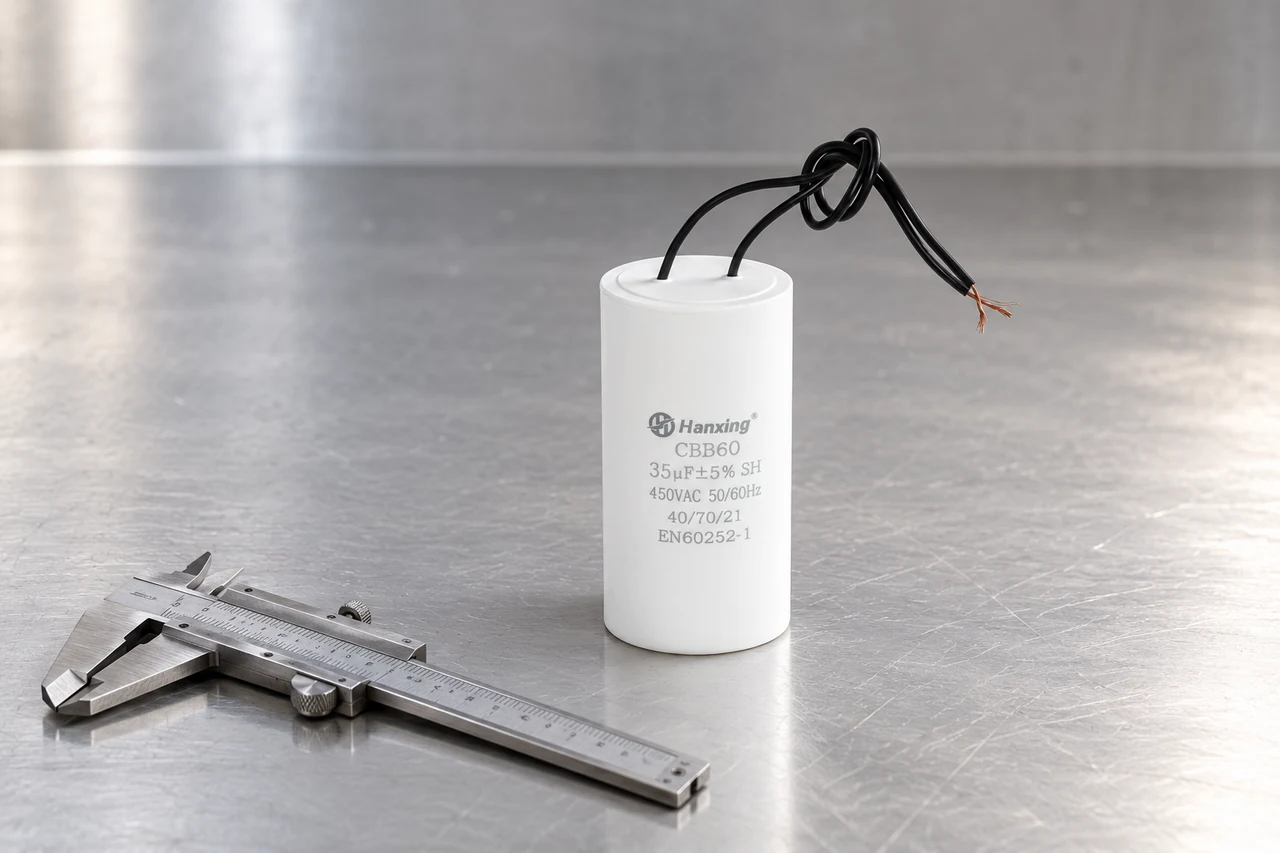
Use the appliance and motor model to identify the original capacitor’s function and part number. A motor run capacitor and a mains interference filter have different jobs. Their appearance or a shared 450 V marking does not establish that they are interchangeable.
First distinguish the motor capacitor from the mains filter
A capacitor-run motor uses a film capacitor in its auxiliary-winding circuit. The mains filter suppresses electrical interference at another point in the appliance. An inverter-driven washer can use a different motor and power-electronics arrangement. Locate the part on the correct appliance diagram before selecting a replacement.
Cylindrical CBB60 and rectangular CBB61 formats are used on selected compatible appliance motors. Neither format is a universal washing-machine part. The exact motor specification establishes µF, VAC, run or start duty and frequency, including any 50 Hz or 60 Hz version difference.
What do four terminals mean?
Some terminal ends provide more than one blade for the same electrical connection. Other assemblies have multiple capacitor sections. The model drawing identifies which applies. Counting blades or copying wire positions from another appliance risks connecting the wrong section or node.
For a stud-mounted replacement, record the stud thread, nut arrangement and the space beneath the mounting surface. For a wired part, retain the lead length, connector and exit direction. The connected envelope includes the plug and wire route, so the case dimensions alone are insufficient.
Testing a suspected motor capacitor
A swollen or cracked case, leakage or damaged terminals calls for the part to be removed from service and the cause investigated. A normal-looking case does not establish a good capacitor. Poor starting or rotation can also result from wiring, controls, supply or mechanical faults.
A qualified technician measures capacitance with the appliance isolated, the capacitor safely discharged and disconnected from the circuit. Compare the result with the marked nominal value and tolerance. Insulation-resistance tests require a suitable instrument and specified method; a capacitance reading alone does not certify insulation quality.
Find a motor capacitor for the appliance
Include the appliance model, motor reference, original label and terminal-end photo for a replacement proposal.